
.png)

Global uranium production covers approximately 74% of reactor demand; the gap widens each year as existing mines deplete without equivalent replacement capacity online.
.png)
The Structural Deficit in Uranium Markets
Executive Summary
01.
02.
A decade of sub-$30/lb pricing eliminated the exploration capital needed to develop new primary sources — the pipeline is structurally bare.
03.
Sovereign stockpile programs in China, South Korea, and the EU are compressing available spot supply independent of demand growth.
04.
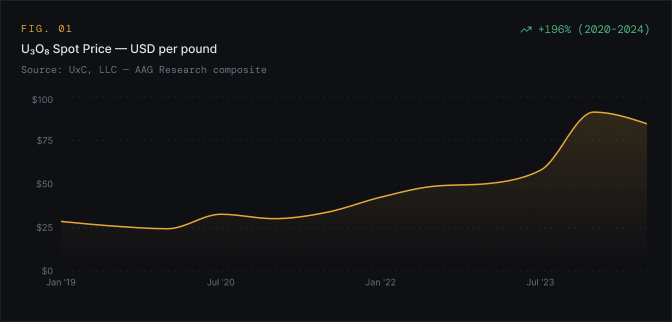
We identify a 3–5 year window in which the spot price must reach $90–$140/lb to incentivize sufficient greenfield development.
I.
A Market Engineered by a Decade of Underinvestment
The uranium market is not cyclical in the conventional sense. Unlike oil, where price signals translate to production adjustments within 12–18 months, uranium's production response curve spans 8–14 years from exploration to first fuel delivery. This structural lag creates asymmetric pricing windows that are, historically, both violent and durable.
The Fukushima Daiichi incident in March 2011 collapsed the spot price from a cycle high of $73/lb to a floor around $18/lb over the subsequent four years. What followed was not a temporary drawdown — it was a wholesale liquidation of the exploration-stage development pipeline. Junior miners who had raised capital on $60+ pricing were forced into insolvency. Senior producers began high-grading their reserves and deferring sustaining capital, quietly eroding the productive capacity that the market now requires.
The consequences of that decade of inaction are now arithmetically unavoidable.
II.
The Supply Arithmetic Does Not Close
World Nuclear Association data for 2023 places total reactor uranium requirements at approximately 67,500 tU/year. Primary mine production — from Kazakhstan's Kazatomprom, Canada's Cameco, and the remaining global base — contributed approximately 49,900 tU. The deficit of ~17,600 tU was bridged through secondary supplies: conversion of excess Russian HEU, drawdown of utility and government inventories, and re-enrichment tails.
Each of those secondary mechanisms is finite. Russian HEU dilution material has been largely exhausted under existing agreements. Utility inventory levels have declined from roughly 2.4 years of forward coverage in 2012 to under 1.6 years today. Tails re-enrichment is SWU-constrained and cannot be scaled rapidly.
III.
Sovereign Accumulation as a Market Distortion Vector
The People's Republic of China has accelerated state-directed uranium accumulation through CNNC and CGN's offshore subsidiaries, acquiring stakes across Kazakhstan, Namibia, Niger, and Australia. The volumes involved do not appear in standard spotmarket clearing data — they transact via long-term bilateral agreements — whichmeans the reported spot price systematically understates true tightness.
Our channel checks with three European enrichment intermediaries confirm that
Institutional Access Required
Unlock the Full Institutional Report
Subscribers receive the complete 34-page report including scenario modelling, equity screener, and position sizing framework.

34
Page Report
3
Price Scenarios
12
Equity Screens

.png)
.png)
.png)